
READ TIME: 9 MINUTES
—
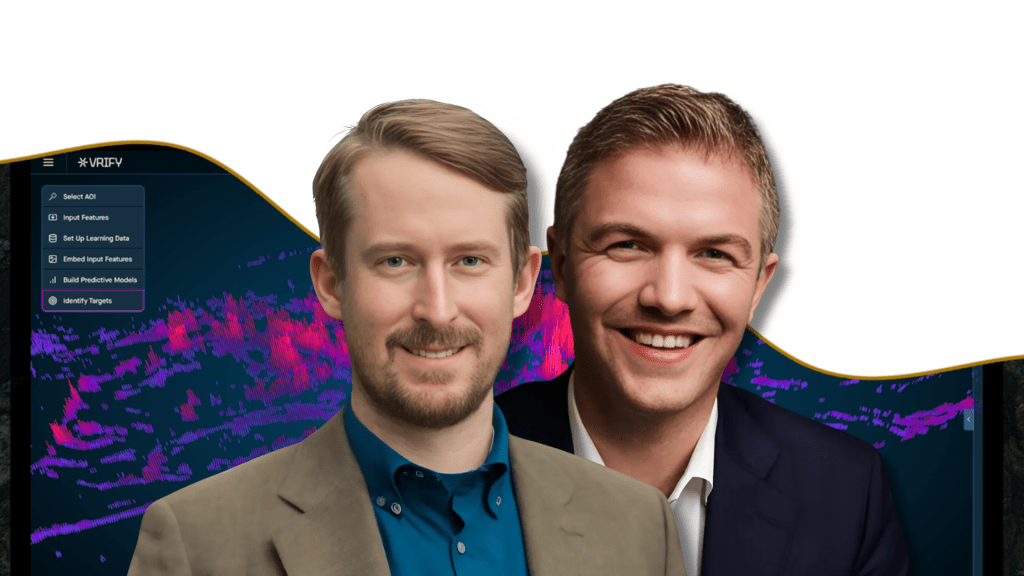
VRIFY is a private technology company that builds AI-driven tools for mineral exploration, combining predictive modeling, geoscience consulting, and 3D data visualization. This conversation with CEO Steve de Jong and Head of Geoscience Jean-Philippe Paiement covered how VRIFY’s platform leverages artificial intelligence to interpret complex geological datasets, generate exploration targets, and update predictive models in near real-time. We talked about whether AI is more than a buzzword in mining, how it fits (or doesn’t) with industry culture, whether it adds genuine value or just marketing sheen, and how investors can separate science from storytelling as companies begin drilling AI-generated targets in 2025.
TL;DR
- 1. VRIFY uses AI to analyze multi-layered geological datasets and generate mineral exploration targets, aiming to enhance (not replace!) geoscientific interpretation.
- 2. The platform is built to be transparent, offering users visibility into what data influenced predictions and allowing iterative modeling as new information becomes available.
- 3. AI is only as good as the data it receives, and VRIFY addresses this by aggregating and anonymizing data from multiple projects to train more robust models.
- 4. The company emphasizes that AI adoption in mining depends on education and integration into workflows, not on replacing geological expertise.
- 5. Several companies are drilling VRIFY-generated or AI-validated targets in 2025, which will provide the first tangible test of the technology’s effectiveness in the field.
Why Should Anyone Care About AI in Mineral Exploration?
Jean-Philippe Paiement, VRIFY’s Head of Geoscience, argues the real value of AI in exploration isn’t to replace geologists, but to enhance their ability to work with complex datasets. “As a human, you’re stuck in two or three dimensions,” he said. “With AI, you can feed in 50 or 60 layers of data and still extract meaningful correlations.” The aim isn’t to automate intuition, it’s to increase the velocity and depth of data interpretation.
Steve de Jong, VRIFY’s CEO, sees it in simpler terms: “Why not?” In an industry with “abysmal” discovery rates and chronic difficulty raising capital, any tool that might move the needle is worth trying. “AI is not going to make exploration success rates worse. So why wouldn’t we explore the opportunity?”
How Do We Know AI Isn’t Just Another Hype Bubble?
The skepticism is warranted. The industry has seen its share of fads; blockchain, helium, asteroid mining, carbon credits, all packaged with slick marketing but short on results. De Jong is aware of the parallel: “It’s not like putting minerals on a blockchain,” he said. “We’re fundamentally talking about changing how discoveries are made.”
Paiement, with a decade of AI experimentation behind him, admitted the term has been abused. “People slap ‘AI’ into a press release to boost the stock,” he said. VRIFY claims to counter that by embedding AI within practical workflows, accessible to end-users, rooted in geology, and producing measurable outputs.
One method they highlight is validation via withheld drill data. “We take a data set, remove 20%, predict, and then reinsert to see how accurate it is,” said de Jong. “That’s like blind drilling an AI-generated target.”
Are Geologists Being Replaced?
Bluntly: no.
“It’s just a tool. “We had two geologists on staff a year and a half ago. Now we have 15, and 10 job openings.” VRIFY believes AI will change the role of the geologist, not eliminate it.
The geologist who knows how to work with AI will outpace the one who doesn’t. “It’s like outrunning a grizzly,” said de Jong. “You don’t have to outrun the bear, just the other geo.”
Can AI Be Trusted?
The conversation veered into epistemology.
What makes AI’s answer trustworthy? De Jong contrasted VRIFY’s AI with chatbots like ChatGPT. “We’re not trying to predict the end of your sentence,” he said. “We’re trying to make predictions based on mineralized vs. unmineralized drill intercepts. And we return confidence metrics and feature importance scores with every prediction.”
Importantly, the VRIFY AI is not a black box. Users can isolate individual data layers and examine their weight in the model. “You can see what data drove the target,” said Paiement. “And if something looks off, a good geo will catch it.”
Can AI Learn From Mistakes?
Yes, misses are valuable. “We train it on positive and negative examples,” said Paiement. “If you thought a target was good and it wasn’t, reintroducing that miss helps refine future predictions.”
More importantly, it’s fast. A model can be rerun in under 30 minutes. “You get a big miss in the field, plug it in, rerun the model, and it updates your next targets. You don’t wait six weeks to recalibrate the plan.”
How Can Investors Spot AI Lipstick on a Pig?
With AI splashed across investor decks, how can a shareholder distinguish science from marketing fluff?
“The share price might go up in both cases,” de Jong admitted. “You have to ask the right questions.” That means drilling down on how AI is used, what decisions it changed, and whether the outputs led to anything tangible. “Ask them: how did this influence your exploration plan? What did you see that you didn’t see before?”
Paiement agreed. “If they can’t explain the input data or how it influenced targets, it’s probably just dressing up a PowerPoint.”
Is VRIFY a Tech Company or a Discovery Engine?
Even they’re not sure. “We’ve debated that a lot,” said Paiement. “Are we SaaS? A consulting firm? A visualization tool?”
VRIFY has three business pillars: AI-based targeting, technical support and education, and visualization. “It’s all pointless if you can’t raise capital around your targets,” de Jong said. “So we still care a lot about how you communicate results.”
Is the Industry Ready for This?
Paiement admitted the culture gap is real. “It’s not a natural fit. We walk into rooms with 65-year-old geos using crayons 30 years ago. But we’ve converted 90% of them.”
Skepticism is expected. But once geologists see how AI can reinforce, or challenge, their existing hypotheses using their own data, conversion often follows. “We’re not ChatGPT for rocks,” said de Jong. “This is built from the ground up by geologists for geologists.”
How Long Before We Know if This Works?
“We’ll know this year,” said de Jong. “2025 will be the year of the AI discovery.”
VRIFY says 30 companies are currently using their AI platform, with several drilling targets in 2024 that were either generated or validated by their model. Rua Gold, Canara Minerals, Kingfisher Metals, and Calibre Mining are among those cited. “Not all will publish results right away,” said de Jong. “But we’re tracking them.”
What Does It Actually Do?
VRIFY’s core product, dubbed DORA, is a browser-based tool that runs predictive models based on multiple geoscience data layers. It’s “data agnostic” (works with any geophysics, geochem, structure, etc.) and “scale agnostic” (works from 5x5km to 300x300km).
Users select their data inputs, define mineralized and unmineralized zones, and choose from a suite of pre-trained models (e.g., porphyry, VMS, orogenic gold). The system generates a predictive map with probability scores for each pixel, viewable in 2D or with predicted depth.
Crucially, users can see which data layers influenced a given target. “You’re not just getting a blob, you’re getting the reasoning behind it,” said Paiement.
What Does It Cost?
It’s priced at “the cost of one drill hole,” according to Paiement. Annual subscriptions come with unlimited modeling and technical support. De Jong said they’re willing to subsidize early adopters, especially those actively drilling: “If you’re putting steel in the ground, we’ll find a way to work with you.”
There’s no retail investor access yet, but a view-only mode for non-technical users is in development.
Will They Ever Sell the Targets?
No. VRIFY says confidentiality is sacrosanct. “If a client doesn’t want to drill a target we’ve identified, we don’t share it, market it, or stake it,” said de Jong.
Can AI Discover Only What We Already Know?
Yes, and no. Paiement acknowledged that AI models are constrained by the data they’re trained on. “They won’t invent a new deposit style,” he said. “But a lot of known styles are still hiding in plain sight.”
Both men challenge the narrative that all the easy deposits have been found. “That assumes we’ve perfectly analyzed every dataset in the industry,” de Jong said. “We haven’t. Not even close.”
Does It Work Better on Certain Deposit Types?
Surprisingly, not really. VRIFY has had success across porphyry, VMS, lithium pegmatite, and structurally hosted gold systems.
Paiement noted an early test with Southern Cross Gold mapped vertical ore shoots with high accuracy. “We’ve seen systematic model accuracy over 80%,” he said.
Still, limitations exist. Narrow-vein gold systems have smaller alteration footprints, making them harder to spot than, say, porphyries with massive halos.
Is the Model Just Garbage In, Garbage Out?
No, says VRIFY. Their backend models are trained on curated, cleaned datasets by a scientific team. “It’s not just your data,” said Paiement. “It’s everything we’ve ingested, public and proprietary, from other projects of the same deposit type. All anonymized.”
The result? Even if you’ve only got a couple of drill holes and a mag survey, the model benefits from the entire ecosystem of similar projects.
What’s Next?
If 2025 proves to be the “year of the AI discovery,” as de Jong predicts, the model’s credibility will rise, and so will scrutiny. But VRIFY isn’t just betting on science. It’s betting on transparency, education, and early results to carry it through.
The AI buzzwords are everywhere. But the litmus test remains: does it get drilled, and does it hit?
Watch the rigs.
VRIFY CEO Interview
VERY IMPORTANT WARNING
Please note that although none of the companies mentioned herein have paid Resource Talks for the creation of this content, this website is a business that charges for the creation and publication of content. This means there will always be a potential conflict of interest which means you can never rely on anything said herein.
By consuming this content, you acknowledge that Resource Talks and/or its affiliates and/or their personnel may own, have owned, or will own interests in and/or may have a business relationship with some or all companies/entities mentioned/featured in this publication. You further acknowledge that entities which may be referenced or featured in this publication or their related parties may hold an interest in Resource Talks or its affiliates, which may create further conflict of interest.
The information provided herein is general & impersonal in nature and meant for entertainment purposes only. The reader acknowledges and agrees that the information does not constitute a solicitation of an offer to buy or sell any security or instrument or to participate in any trading strategy. The author is not a licensed investment advisor. He is just another talking head on the internet. He might own shares of companies mentioned in this publication. Always assume he doesn’t know much more than a potato does. The mining & exploration space is among the riskiest sectors to invest in. The risk of anything mentioned in this publication is 100% loss of capital. If you don’t read the official documents provided by the company on http://www.SedarPlus.ca, you will lose all of your money.